
Marketing to Gen Z in Vietnam: What International Brands Need to Know
Marketing to Gen Z in Vietnam: What International Brands Need to Know
Vietnam’s Gen Z is reshaping how brands communicate, build communities and earn attention.
Born into a highly connected digital environment, this generation does not simply consume advertising. They discover brands through social media, creators, communities, experiences and conversations with their peers.
For international brands entering Vietnam, this creates both an opportunity and a challenge. A global campaign may have worked successfully in another market, but simply translating the message into Vietnamese does not guarantee local relevance.
To connect with Vietnamese Gen Z, brands need to understand not only what this audience buys, but also what they value, how they interact with brands and what makes an experience worth sharing.
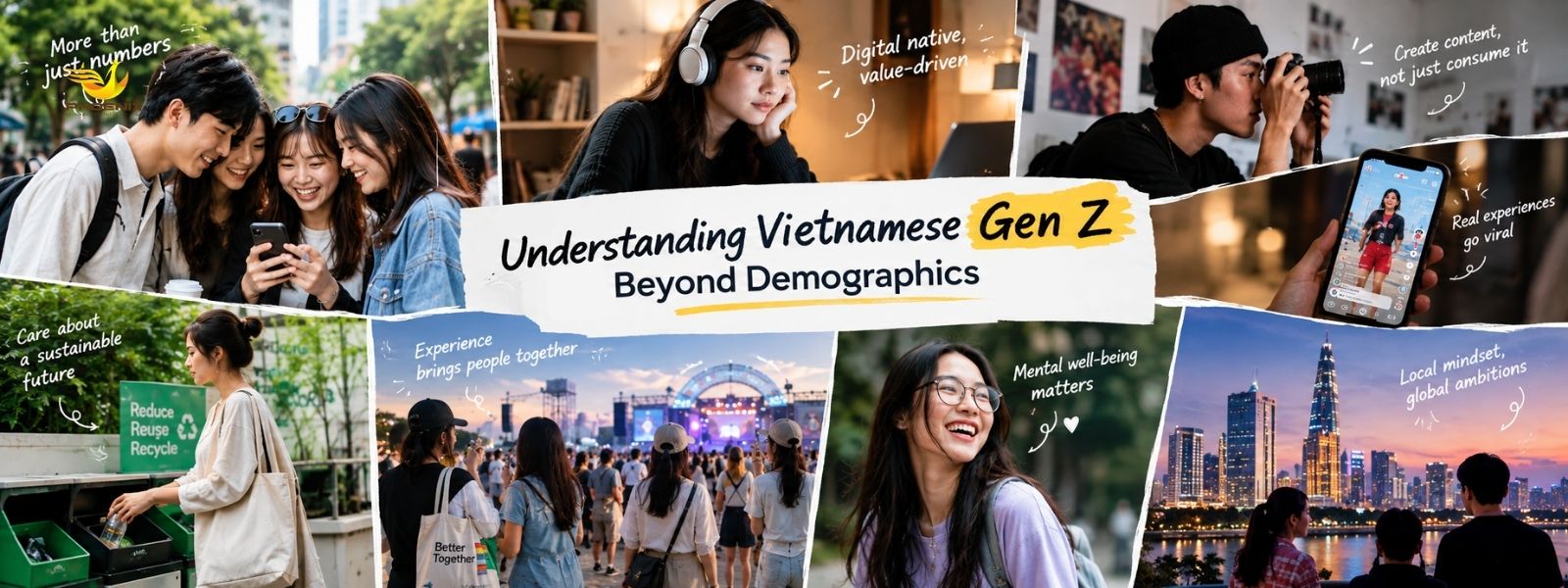
1. Understand Vietnamese Gen Z beyond demographics
Vietnamese Gen Z is often described as a digital-first generation. They are highly familiar with short-form video, social platforms, online communities and creator-led content.
However, digital behavior alone does not define them.
They are also influenced by cultural context, social relationships, lifestyle aspirations and the brands they see as relevant to their generation.
For international brands, this means that localization should go beyond language.
The same campaign concept can be interpreted very differently in different markets. Visual language, humor, cultural references, social issues and even the way a brand speaks to consumers may need to be adapted for Vietnam.
The question is not simply:
“How do we translate our campaign into Vietnamese?”
It is:
“How should our brand behave in Vietnam?”
That distinction can significantly influence how a brand is perceived locally.
2. Authenticity Matters More Than Perfect Brand Messages
Vietnamese Gen Z has access to an enormous amount of information every day. They can compare brands, research products, review opinions and share their experiences almost instantly.
As a result, polished advertising alone is not enough to create trust. Brands need consistency between what they say and what they actually do.
A brand that communicates sustainability, inclusivity or social responsibility will increasingly be expected to demonstrate those values through real actions.
This is particularly important for international companies entering Vietnam. A global brand may already have established values and communication guidelines, but those values still need to be expressed in a way that feels relevant to the local market.
Localization is therefore not about changing the brand’s identity.
It is about finding the most credible way for that identity to live in Vietnam.
3. Champion Social Responsibility and Mental Well-being
Vietnamese Gen Z is increasingly attentive to issues such as sustainability, inclusivity, mental well-being and community impact.
This does not mean every brand needs to build its entire marketing strategy around social causes. The more important point is authenticity.
If a brand has genuine environmental initiatives, responsible sourcing, recyclable packaging or community programs, those efforts can become meaningful parts of its communication.
But brands should avoid turning social responsibility into a purely promotional message.
Today’s digitally connected consumers can quickly investigate claims, compare information and challenge brands when communication does not match reality.
For international businesses, this creates a clear communication principle:
Do not simply tell Vietnamese consumers what your brand believes. Show them how the brand behaves.
That difference can determine whether a campaign feels credible or performative.
4. Create Physical Experiences Worth Sharing
Vietnamese Gen Z may spend significant time online, but that does not make offline experiences less important.
In fact, physical experiences can become powerful sources of digital content.
Cafés, pop-up stores, product launches, exhibitions, brand activations and experiential events can create moments that audiences want to photograph, film and share.
This is where physical and digital marketing increasingly overlap.
A well-designed activation is no longer simply an event that happens at a particular venue.
It can become a content ecosystem. A creative installation can generate photographs. An interactive experience can generate short-form videos. A product demonstration can become creator content. A memorable event can continue circulating online long after the physical experience has ended.
For brands launching products in Vietnam, this creates an opportunity to design the offline experience with online behavior in mind.
The objective is not simply to create something that looks impressive.
It is to create something that people naturally want to experience, capture and talk about.
5. Design for Both Experience and Content
One of the challenges international brands face in Vietnam is the separation between marketing communication and event execution.
A campaign may have a strong digital concept, while the physical activation feels disconnected from it.
The opposite can happen as well: an impressive event may generate strong visual material but fail to communicate the brand message clearly.
The strongest campaigns connect the two.
The creative idea should work across social content, physical environments, audience interaction and post-event communication.
This is particularly relevant for product launches, brand activations, exhibitions and corporate events.
Instead of treating the event as the final stage of a campaign, brands can consider the event as one of the places where the campaign comes to life.
That shift can create a more consistent brand experience across online and offline touchpoints.
6. Local Relevance Does Not Mean Losing the Global Brand
International brands sometimes face a difficult balance when entering Vietnam.
How much should be standardized globally?
How much should be adapted locally?
There is no universal percentage or formula.
A strong global brand should retain the elements that make it recognizable while adapting the way those elements are expressed to the local audience.
Brand identity, positioning and core values may remain consistent.
The storytelling, cultural references, content formats, event concepts and consumer experience may require greater localization.
This is where local market understanding becomes valuable.
A Vietnamese audience does not necessarily need a completely different brand.
They need a brand that understands how to communicate naturally in their environment.
7. From Digital Attention to Real-World Brand Experience
For international brands entering Vietnam, the opportunity is increasingly found between digital communication and physical experience.
Social media can create awareness.
Creators can create conversation.
Digital campaigns can drive attention.
But physical experiences can give consumers something tangible to remember.
When these elements are connected, a product launch or brand activation can become more than a single marketing event. It can create content, interaction and conversations that continue beyond the original campaign.
This is especially relevant in a market where consumers are highly connected and increasingly selective about which brands deserve their attention.
Marketing to Gen Z in Vietnam Requires More Than Translation
Vietnamese Gen Z is not simply a younger consumer segment waiting for international brands to advertise to them.
They are active participants in the brand conversation.
They discover. They compare. They create content. They share experiences. And they influence the people around them.
For international brands, entering Vietnam therefore requires more than translating an existing global campaign.
It requires an understanding of local culture, consumer behavior, communication channels and real-world experiences.
At Phoenix Multimedia Communications, we combine international marketing standards with local market understanding to help global brands build meaningful connections in Vietnam.
From brand positioning and creative development to experiential marketing, brand activation and event execution, Phoenix helps international businesses translate their global vision into experiences that feel relevant locally.
Looking to launch, grow or activate your brand in Vietnam?
Let’s build an experience that Vietnamese audiences can understand, remember and share.